I was sick all week, with not much drive to do anything, so I found myself with some time to pass in the evenings after the girls went to sleep before I went to pass out myself. I admit I’ve been having a bit of trouble holding my strategy in the last few months, with the nasdaq 100 now up a whopping 54% YTD. Its actually insane, and I’ve been trimming positions, taking profits on my 33% year becauseI don’t want them to evaporate. On the other hand, taking profits isn’t a strategy, nor is timing the market IMO. Time IN the market is far more important that TIMING the market, as is obviously apparent if you look back 6 (or more) years:
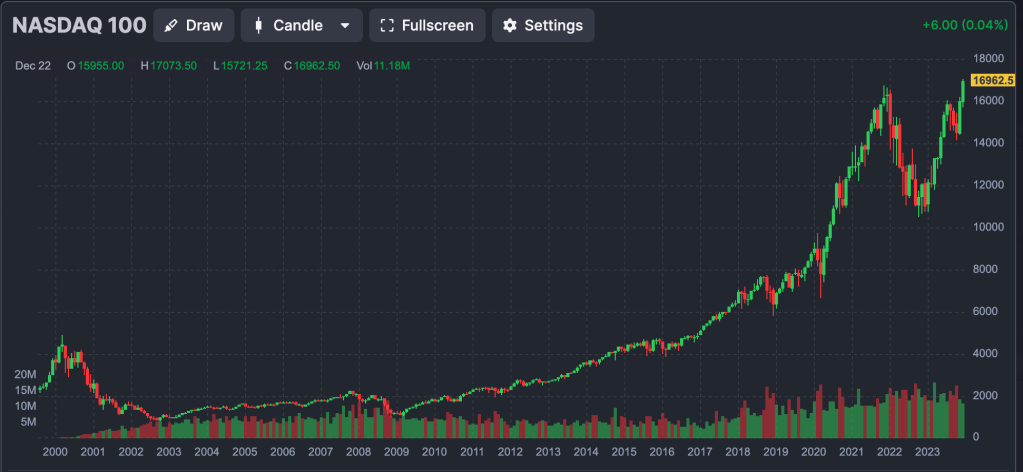
I started managing my portfolio in ~2017, and WHATEVER I had bought at that time, I would have doubled/tripled/4x whatever since then if I had just bought and held, let alone if I had done long term bullish options strategies.
Nonetheless, what happened in 2022 (especially in the end) was BRUTAL to me and my portfolio, and although overall now over the last 2 years, my porfolio is up 16% to the nasdaq 100s 6.5%:
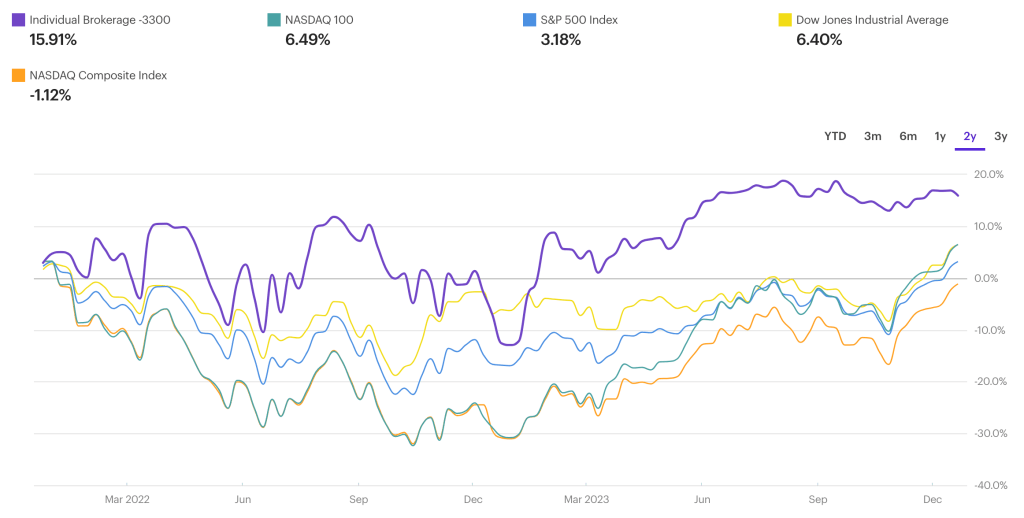
I would like to try to avoid a repeat of the drawdown in my porftolio that was the end of 2022. And while I’m only ~50% invested, that still means that if I need to double down on ALL of my positions I will be 100% invested. And of course thats a bit of an exaggeration, I’m not 50% invested, I wouldn’t need to double down on all my positions, but still – this is the YTD performance of many of the companies I own:
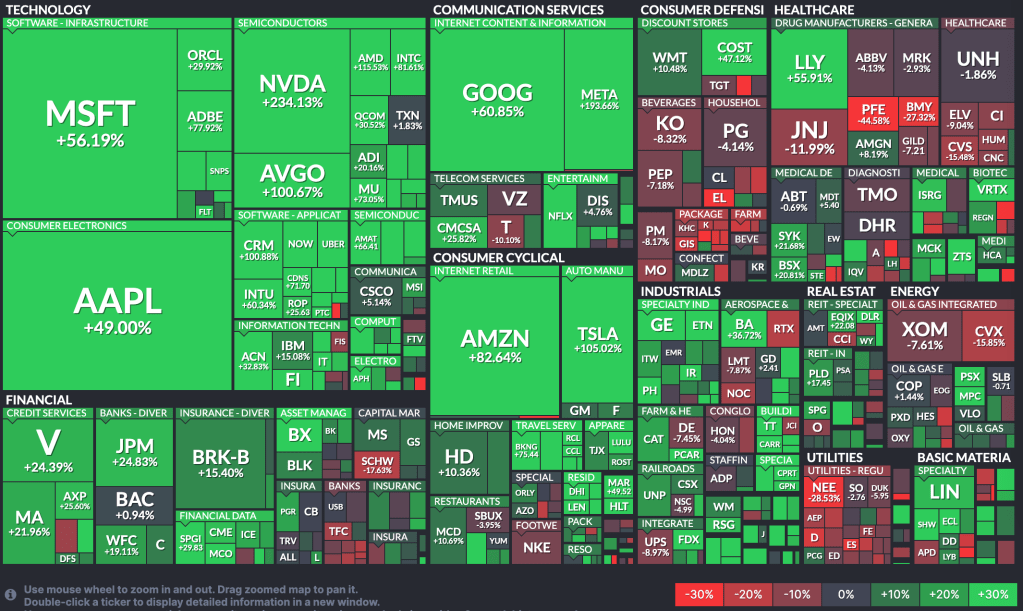
Which means that just like MSFT, AAPL, GOOG, AMZN, LLY went UP 50% (or more) this PAST year, they could just as easily go DOWN the same amount this COMING year.
So I’ve been digging through my portfolio relentlessly, trying to figure out how best to proceed.
Firstly I took profits on almost all my multiple short LEAP put contracts on any single company I own, leaving 1 “placeholder” LEAP contract to prove to myself that they just always win. The problem with that is that if the market does stay horizontal or go up, I wont make my 10%/year based on so few contracts.
So I started doing more double-covered BPS – which will pay off nicely before they start losing money, and they all have high (statistical) probabilities of success. They problem though is similar to above – in a horizontal/up market, they don’t make me any money, and thats why in the recent 20% run up of the nasdaq my portfolio has pretty much stayed the same. That and SPWR disctintegrating. The other problem though is that on a SHARP downturn, where any of the above mentioned companies lose 30-70%, I will get tied back into a similar situation I was at the end of 2022 – relatively highly invested, but having bled so much money (esp in the last month) that I was hesitant to double down too early. And obviously, hindsight 20/20, if I had bought (or sold options on) any of AAPL@130, AMZN@90, META@130 or whatever they were at the end of 2022 I would have done better, but that feeling at the end of 2022 where my decent performance on a singularly bad year just discintegrated before my eyes (obviously to come back in 2023), I just wasn’t confident enough to look at the big picture, take a deep breath, and pursue my strategy wholly, so I just kindof held on and crossed my fingers (actually a pretty good investment strategy 🧐).
So I’ve been tryng to analyze this year and I came across this cool view – YTD gains per company (realized or paper):
Cool statistic right? And some important conclusions can be drawn from it:
- My biggest loser – SQQQ. But that kindof makes sense on a year the nasdaq went up 50%, the 3x inverse was my biggest loser. Anyway – is it worth hedging? I don’t know. Also my 5th biggest loser was VIX, another hedge, which again, on a 50% nasdaq year, makes sense.
- My biggest winners were the companies I was “overinvested” in at the end of 2022 – AMZN + TSLA took ~30% of my portfolio margin last year…. EACH! Which also makes sense, because they both bounced back in 2023 (up 80-100%), and you gotta risk to earn. But 120/140k of my overall gains were from those 2 companies. And that kindof demonstrates what many investing school teach and I actually read a version of this morning on Sam Altmans blog – “Concentrate your resources on a small number of high-conviction bets; this is easy to say but evidently hard to do.” Definitely hard to do. Or maybe whats hard for me is having conviction, at least in this area of my life, definitely not in other areas. I always feel like the crash of 2000/2008/2020(which now looks like a blip but at the time was the end of the world!!)/2022 is right about to happen. Maybe I was traumatized by it, I did read a long time ago that the environment you were brought up in is the largest factor driving your investing outlook – not exactly that but something like that, I forget where I read it, wish I could find the article to re-read it, but basically it said if you grew up in the great depression and felt it, even as an adult in the 40-50-60s, you subcounsiously were affected by your youth and what happened. And I was brought up in the dot com bubble – I remember us making a f*ck ton of money in the 90s, saying thank you AAPL for this dinner, thank you blabla for this treat, and then I don’t really know about losing how much, but my dad got laid off in 2002ish and I definitely remember bad moods, grumbling, or joking about having so much and then losing it, or losing so much, or whatever. So yeah, thats definitely in me.
Anyway, I want to end with a final reinforcement to my (future) self (and my individual readers 😅) and to anyone new here who comes across this post by chance and gets this far down – who are looking for sound, statistically successful investment advice:
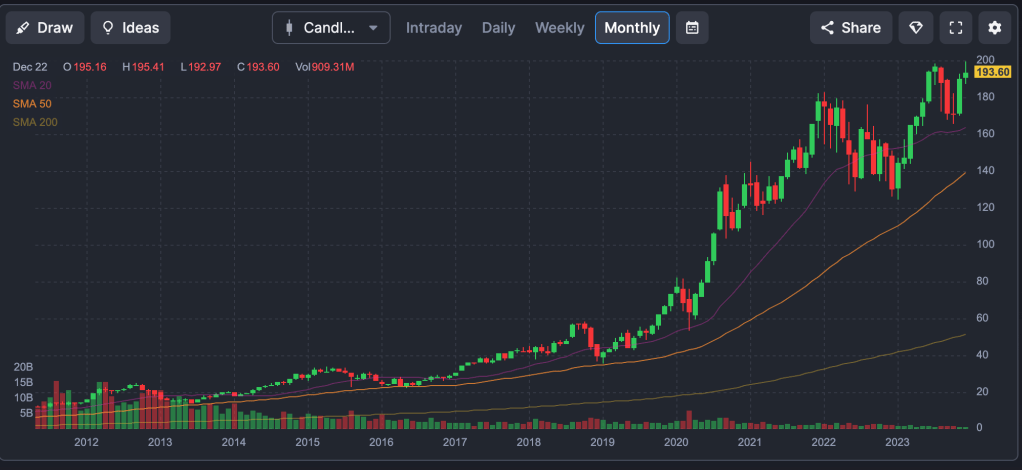
Lets open the graph of any company – I like AAPL so lets go with them. This is the last 3 years of AAPLs stock price:
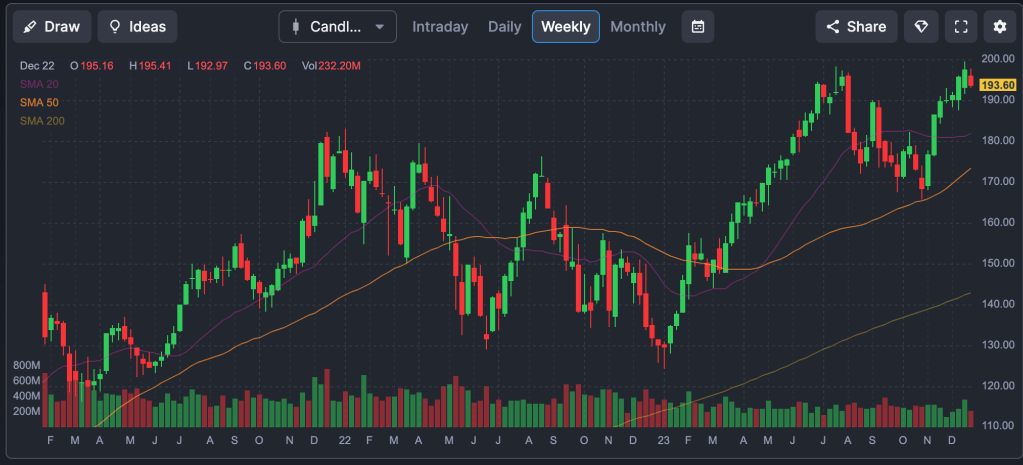
Currently at 193, and I don’t know if they will go up or down from here, so I can’t tell you if its a good time to buy. What I CAN tell you, is that 140$, 130$, and even 120$, were great (!) times to buy AAPL, at least in the last 3 years. And if you had bought at 120 in March 2021, you would have made 58% over just under 3 years, or ~20% per year. Hindsight 20/20, right? But options do make it possible to choose the lowest price a given company as been in the last 3 years, promise to buy it for that price, and SOMEONE WILL PAY YOU FOR THAT PROMISE! For example, if I promise to buy 100 shares of AAPL @140$ any time in the coming 2 years, someone will pay me 600$ for that promise (or 340$ for 120$). Thats a return of 6/140=4.2% over 2 years = 2.1% for a cash secured put. Underwhelming, to say the least, especially when the interest rates are up around 4-5%, but lets consider what else happened:
- You made 2.1%/year (kindof), while AAPL lost 26%. If you had bought AAPL, you would have been much worse off.
- If AAPL goes down to 140$, its statistically probable the 3 following years will look something like the previous 3 years, meaning that AAPL could go up 58% in the next 3 years, meaning that over the 5 years, you could get a return of 62%ish=12ish% per year. If you had bought AAPL at 190, after the 5 years you would potentially just be back to even.
- With AAPL at 140$ in Jan 2026, you now know you are at the lowest place AAPL has been in the last ~5 years. If you look at ANY TIME in AAPLs history.. ANY time. Any time you could buy AAPL for the lowest it has been in 5 years, was a good time to buy:
So although you made “only” 2% over the last 2 years, you put yourself in a situation where looking forward, if looked at with a cool, level head, you have extremely (!!!) high probability of making outsized returns.
But these razor steel investing nerves are super (!) hard to stick to, because the future is always (!) unknown, and scary, and thats why I’m writing this, and making these calculations, also to convince myself. Because thats kindof the situation we were in at the end of 2022, with AAPL at 130$, after it has been as high as 180, and the previous time it was that low was 2 years earlier, so essentially it was the opportunity to purchase AAPL at its 2 year lows. Or sell 70-80-90$ puts 2 years out. But many contracts, not “placeholder” positions. Back. Up. The. Truck. But at the time, although AAPL had been as high as 180, it was also as low as 60$ (!!!) after the covid fiasco, and who’s to say it isn’t going to continue down from 120$ towards 100->80 or lower, no one knows. What we do know though, is that at the time, statistically, it was a good time to buy AAPL (or sell short puts against it). And even if AAPL did continue down from 130 towards 100 (or less), at that point, if you had ANY money left over, it would be a good time to sell everything you own and buy AAPL, but even if you didn’t have money left over to double down with, if you just held on, its still statistically highly probably that after 2 years AAPL would have gone back up above the 130$ (or 100$) short puts leaving them to expire worthless.
So I guess the moral of the story, and I’m writing this to remind myself as well – although it may seem like it, the end of the world only comes once – at the end of the world. And we haven’t gotten there, at least not yet. And as pessimistic as I am about the world in its current state, with the violence, and pollution, global warming, Trump, Putin, China, Iran, hate, its such a statistically improbably event that when it finally comes, the balance in your bank account will be the least of your worries. And at the end of the worst year for the nasdaq in 50 years (that was 2022), its unlikely that a similar year will follow. And boy has it been a year – a 50% year on the nasdaq! So here we are in a similar (but opposite) situation – at the end of the best year for the nasdaq in 50 years (was it? I didn’t see anything about that but I do assume >50% years are extremely (!) rare), another 50% year is, again, highly unlikely. Which makes holding investments going forward super (!) scary, even though I know (in my mind) that statistically time IN the market is more important than TIMING the market. But honestly, its more important for me to miss a -30% year than to miss another +50% year, and thats why although my portfolio is underperforming the nasdaq, I’m much happier underperforming a 50% year and outperforming a -30% year than the opposite. And if over the rollercoaster that was 2022-23 where the nasdaq went down and up 30% and my portfolio made 16%, hopefully I can continue that over the next 2 years.
I’ll do one last calculation on my porftolio of how much I have left to gain if all my short options expire worthless, to give myself an idea of how much potential I have over the coming 2 years, just to have a record of it:
So basically $85k, where my cash available is 313/633k – so basically 50% invested (not ALL of that margin req is LEAP short puts – there are also 1-2mo double covered bear put spreads which unless the market tanks >10% in the next month will mostly expire worthless). Either way – call it 85/633=13.4%/2 years = 6.7%/year to gain if the market goes sideways or up. Which honestly is less that I’d LIKE to make a year (my goal is 10-20%), but with the VIX at 15$, down from 21 in November, down from 30+ in 2022, I’m happy to wait a couple of months for a pop in the VIX, maybe for the next expiry options to come out, before adding some more positions.
And honestly, I recommend dollar cost averaging as a strategy I recommend, supercharged by cash secured puts instead of buying stock if you are so inclined – heres a foolproof strategy for someone who wants to invest and forget, with an extremely high probability of success:
- Divide your money into say 12 or 16 equal chunks, and each quarter, when new options come out, choose a company from the megacaps (100B+ market cap), find its 3 yr lowest value, and sell the farthest out puts of that stock, enough contracts which use the 1/12 (or 1/16th) of your margin requirement. Rinse and repeat every quarter when new contracts come out, either with a different company, the same company, or doubling down and out (if necessary) on a position you already own.
- Alternatively, instead of doing it every quarter, set an alert on VIX>level of your choosing, and use that as a trigger to invest 1/12 (or 1/16) of your money in a similar method as above.
- In this way, after 3-4 years, you should be invested something around 25-75% (depending on which direction the market went over those years). As positions expire and margin frees up more than 75%, add another position, rinse and repeat.
In the next post I’ll elaborate on this a bit with a concrete example, but for now, that will be all for this EXTREMELY LONG post, happy holidays!
 Hab Technology